

- IMO
- 7429061
Composite Risk
Risk Score
Strong, corroborated adverse evidence — a detention, sanctions exposure or a dark-fleet signal.
A coverage-weighted blend of the single component we could read for this hull — the weights renormalise over only the components present, so a thin read is never inflated and a hull is never credited a “safe 0” for a signal it has no row for. This headline is flagged low-confidence (a thin or structural-only read) and should not be treated as a verdict. Higher means riskier. Derived in-house from government-open port-State-control, flag, sanctions and our own vessel data; weight it by the coverage above.
Commercial
Voyage Estimate
Overview
About This Vessel
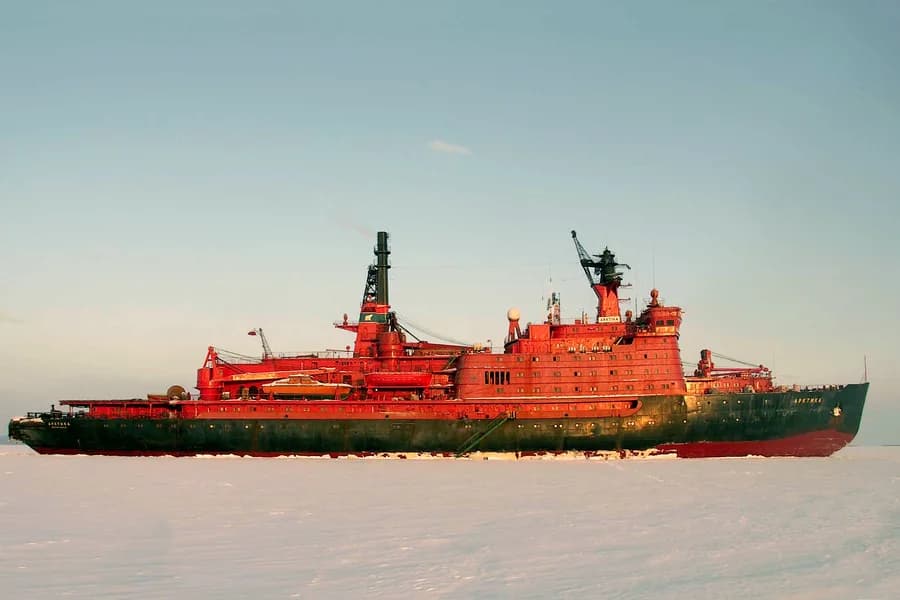
Arktika (Russian: А́рктика, IPA: [ˈarktʲɪkə]; literally: Arctic) is a retired nuclear-powered icebreaker of the Soviet (now Russian) Arktika class. In service from 1975 to 2008, she was the first surface ship to reach the North Pole, a feat achieved on August 17, 1977, during an expedition dedicated to the 60th anniversary of the October Revolution. The Arktika is a double-hulled icebreaker; the outer hull is 48 millimetres (1.9 in) thick, the inner 25 millimetres (0.98 in) thick, with the space in between utilized for water ballasting. At the strongest point, the cast steel prow is 50 centimetres (20 in)) thick and bow-shaped to aid in icebreaking, the curve applying greater dynamic force to fracture the ice than a straight bow would. The maximum ice thickness it can break through is approximately 2.8 metres (9 ft 2 in). Arktika also has an air bubbling system (ABS) which delivers 24 m3/s of steam from jets 9 metres (30 ft) below the surface to further aid in the breakup of ice. The ship is divided by eight bulkheads, providing nine watertight compartments, and can undergo short towing operations when needed. It also comes equipped with a helicopter pad and hangar at the aft of the ship. Mil Mi-2 "Hoplite", dubbed ptichka (Russian for "little bird"), or Kamov Ka-27 "Helix" helicopters are used for scouting expeditions to find safe routes through the ice floes.
Fleet Management
Ownership & Management
Visual Archive
Gallery
Community
Vessel Comments