

- IMO
- 9704130
- MMSI
- 578000800
- Call Sign
- FIRS
Technical Specifications
Key Figures
Live Tracking
Current Position
Where it waited most
Most time stopped at Longyearbyen — 22 h across 4 stays.
- 1Longyearbyen22 h · 4×
- 2Offshore 79.73,11.049 h · 2×
- 3Ny Alesund9 h · 2×
- 4Offshore 78.87,12.647 h · 2×
- 5Offshore 80.39,19.455 h
- 6Offshore 79.63,11.515 h
- 7Offshore 79.72,11.154 h
- 8Offshore 79.52,12.444 h
- 9Offshore 79.60,18.442 h · 2×
Derived from the AIS track — runs of near-zero speed (anchored, moored or drifting) snapped to the nearest port. Builds up as we observe the vessel.
Intelligence
Risk & Sustainability
- AER (CO₂/capacity·nm)
- 21
- Fuel burned
- 744 t
- Technical
- EEDI (21.8 gCO₂/t·nm)
Verified reported figure. Band is peer-relative, not official IMO CII.
- Longyearbyen0.5 dJun 27, 2026
- Ny Alesund0.2 dJun 26, 2026
- Longyearbyen0.3 dJun 20, 2026
- Longyearbyen0.2 dJun 20, 2026
- Ny Alesund0.2 dJun 19, 2026
AIS-derived from our live feed.
Operational Status
Activity
Making way at sea speed on its latest broadcast.
Read from the single most-recent AIS broadcast we hold for this hull — we keep no position history, so this is a point-in-time posture, not a dwell inference. Derived in-house from our own AIS feed; weight it by the broadcast age above.
Port calls
4 recent · AIS-detectedArrivals, time in port and the load/discharge inferred from the draught change — detected from AIS track history. An open call means the vessel is still in port (no departure observed yet).
- no cargo change→ · 12 h in port· draught 4.9→4.7 m
- no cargo change→ · 5 h in port· draught 4.9→4.9 m
- no cargo change→ · 13 h in port· draught 4.9→4.9 m
- no cargo change→ · 5 h in port· draught 4.9→4.9 m
Method: each call is a run of fixes inside a port’s geofence confirmed by a stop (or an AIS gap); load/discharge is the sign of the draught delta over the call. Indicative — arrivals before our AIS history began read from the first observation.
Where it waits
2 ports · 34 h totalTime-in-port summed by port from the AIS-detected port-call history — the ports this vessel has spent the most time at, longest first.
- Longyearbyen· Svalbard and Jan Mayen24 h2 calls · 12 h avg
- Ny Alesund· Svalbard and Jan Mayen10 h2 calls · 5 h avg
Based on 4 completed calls observed since — open calls (no departure yet) are excluded. The distribution sharpens as AIS history accrues.
Composite Risk
Risk Score
No strong adverse signal on the components we could read for this hull.
A coverage-weighted blend of the 2 components we could read for this hull — the weights renormalise over only the components present, so a thin read is never inflated and a hull is never credited a “safe 0” for a signal it has no row for. This headline is flagged low-confidence (a thin or structural-only read) and should not be treated as a verdict. Higher means riskier. Derived in-house from government-open port-State-control, flag, sanctions and our own vessel data; weight it by the coverage above.
Estimated
Capacity & Classification
Other · summer draught 4.7 m · 5.7 t per cm immersion
Estimate only — modelled from deadweight (deadweight regression) using a first-principles hydrostatic model, not measured hydrostatic tables. The design draught it is anchored to is unreliable across the fleet.
Commercial
Voyage Estimate
Overview
About This Vessel
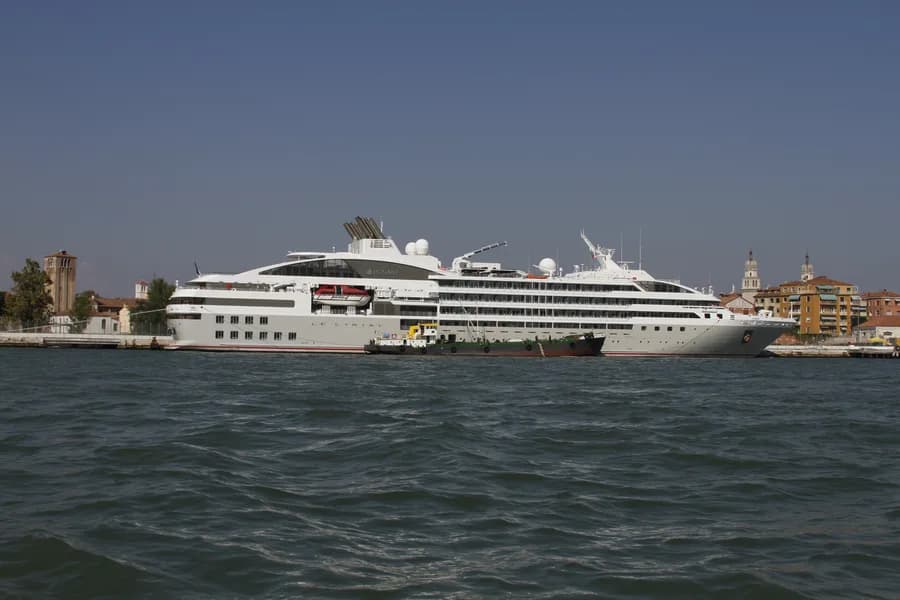
Le Lyrial is a cruise ship built by Fincantieri in Ancona, Italy, for Compagnie du Ponant. It was delivered on 11 April 2015, and operated its inaugural cruise in May 2015. The name of the ship refers to the Lyra constellation in the northern hemisphere.
Fleet Management
Ownership & Management
Visual Archive
Gallery
Explore More
Similar Vessels
Community
Vessel Comments