

- IMO
- 9290531
Intelligence
Risk & Sustainability
- Fuel burned
- 3,653 t
- Technical
- EEXI (8.95 gCO₂/t·nm)
Verified reported figure. Band is peer-relative, not official IMO CII.
Compliance
Safety Record
- Newark, New Jersey8 deficienciesNov 30, 2018US Coast Guard (Tokyo MOU)8 grounds for detention
Reports of non-conf.,; Jacketed high pressure lines; Propulsion main engine Connections within the fuel supply and spill lines shall be; Propulsion main engine The arrangements for the storage, distribution and; Auxiliary engine Provision shall be made to facilitate cleaning, inspection; General alarm An alarm system shall be provided indicating any fault; Steam pipes and pressure; Propulsion main engine In a ship in which oil fuel is used, the arrangements for
Port-State-Control detentions.
Composite Risk
Risk Score
Multiple adverse factors, or a hard ship-specific signal, lift this hull above the fleet norm.
A coverage-weighted blend of the single component we could read for this hull — the weights renormalise over only the components present, so a thin read is never inflated and a hull is never credited a “safe 0” for a signal it has no row for. This headline is flagged low-confidence (a thin or structural-only read) and should not be treated as a verdict. Higher means riskier. Derived in-house from government-open port-State-control, flag, sanctions and our own vessel data; weight it by the coverage above.
Commercial
Voyage Estimate
Overview
About This Vessel
MSC Pamela was built by Samsung Heavy Industries and launched in 2005. The vessel's engine, also built by Samsung Heavy Industries, consumes 248 tonnes of heavy fuel oil per day. The vessel measures 336.6m in length, a draft of 15m, with a gross tonnage of 107,200 and with a breadth of 45.6m (150ft); is capable of a maximum speed of 25.2 knots. She sails under the Panamanian flag for the Mediterranean Shipping Company. At its launch, MSC Pamela broke the world records for the number of containers that could be carried on a single vessel. As a post-Panamax vessel, and therefore unable to pass through the Panama Canal, she operates between the major ports of Europe and the Far East.
Fleet Management
Ownership & Management
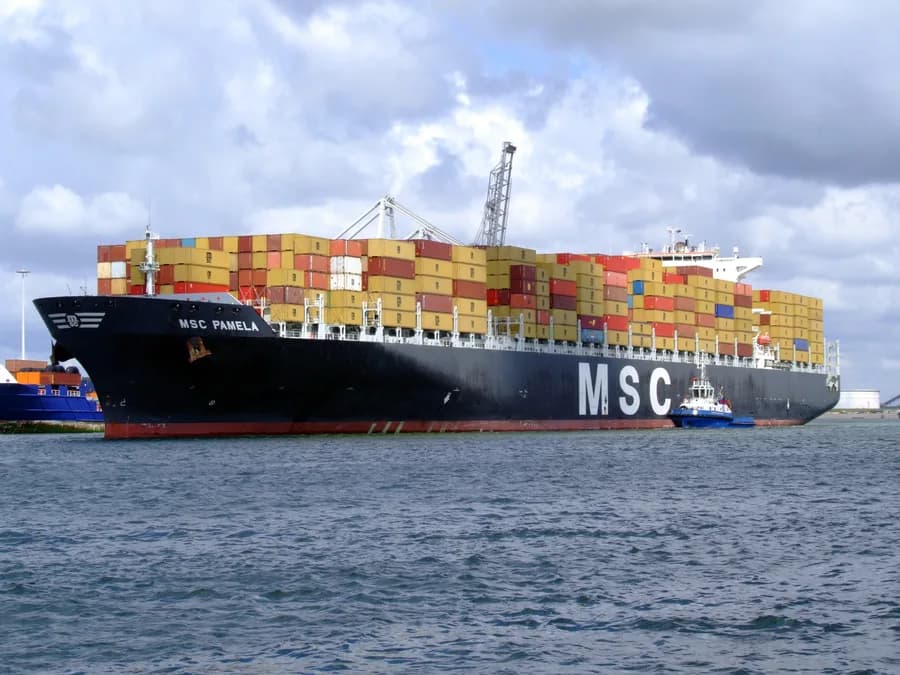
Visual Archive
Gallery
Community
Vessel Comments