

- IMO
- 5262146
- MMSI
- 234990000
- Call Sign
- GFTN
Technical Specifications
Key Figures
Live Tracking
Current Position
Where it waited most
Most time stopped at Bideford — 2 d across 3 stays.
- 1Bideford2 d · 3×
Derived from the AIS track — runs of near-zero speed (anchored, moored or drifting) snapped to the nearest port. Builds up as we observe the vessel.
Intelligence
Risk & Sustainability
- BidefordIn portJun 30, 2026
- Bideford0.6 dJun 29, 2026
- Ilfracombe0.3 dJun 24, 2026
- Ilfracombe0.2 dJun 20, 2026
- Bideford0.6 dJun 18, 2026
AIS-derived from our live feed.
Operational Status
Activity
Making way at sea speed on its latest broadcast.
Read from the single most-recent AIS broadcast we hold for this hull — we keep no position history, so this is a point-in-time posture, not a dwell inference. Derived in-house from our own AIS feed; weight it by the broadcast age above.
Port calls
4 recent · AIS-detectedArrivals, time in port and the load/discharge inferred from the draught change — detected from AIS track history. An open call means the vessel is still in port (no departure observed yet).
- op. unknown→ · 14 h in port
- op. unknown→ · 17 h in port· medium confidence
- op. unknown→ · 20 h in port· medium confidence
- op. unknown→ · 14 h in port
Method: each call is a run of fixes inside a port’s geofence confirmed by a stop (or an AIS gap); load/discharge is the sign of the draught delta over the call. Indicative — arrivals before our AIS history began read from the first observation.
Where it waits
2 ports · 2.7 days totalTime-in-port summed by port from the AIS-detected port-call history — the ports this vessel has spent the most time at, longest first.
- Ilfracombe· United Kingdom37 h2 calls · 19 h avg
- Bideford· United Kingdom28 h2 calls · 14 h avg
Based on 4 completed calls observed since — open calls (no departure yet) are excluded. The distribution sharpens as AIS history accrues.
Composite Risk
Risk Score
Multiple adverse factors, or a hard ship-specific signal, lift this hull above the fleet norm.
A coverage-weighted blend of the 2 components we could read for this hull — the weights renormalise over only the components present, so a thin read is never inflated and a hull is never credited a “safe 0” for a signal it has no row for. This headline is flagged low-confidence (a thin or structural-only read) and should not be treated as a verdict. Higher means riskier. Derived in-house from government-open port-State-control, flag, sanctions and our own vessel data; weight it by the coverage above.
Estimated
Capacity & Classification
Other · summer draught 1.8 m · 0.7 t per cm immersion
Estimate only — modelled from deadweight (deadweight regression) using a first-principles hydrostatic model, not measured hydrostatic tables. The design draught it is anchored to is unreliable across the fleet.
Commercial
Voyage Estimate
Overview
About This Vessel
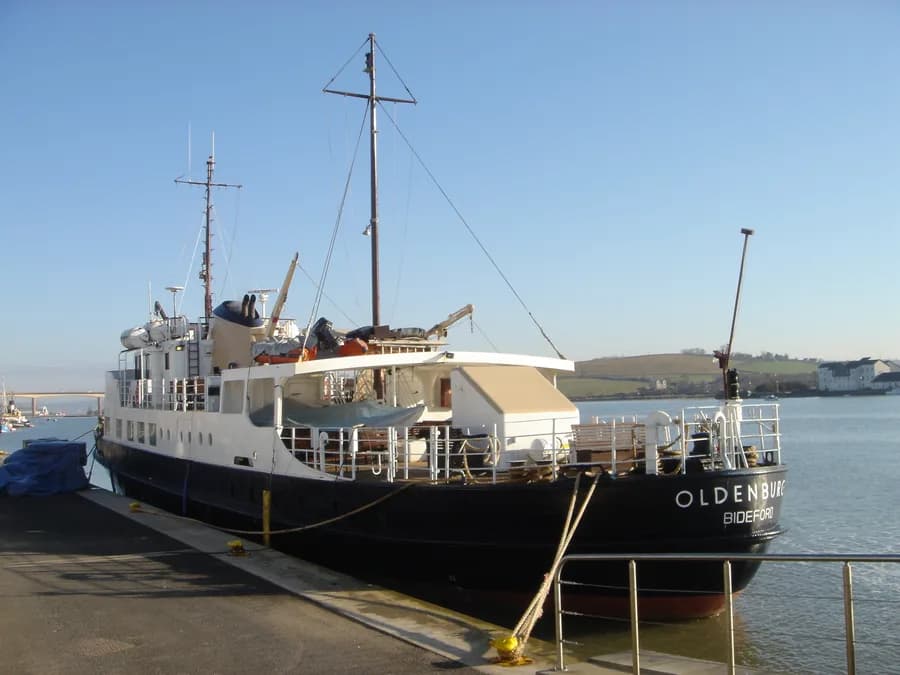
MS Oldenburg is a British passenger ferry serving the island of Lundy in the Bristol Channel. The Oldenburg was named after the former grand duchy of Oldenburg, Germany, and launched on 29 March 1958 in Bremen. On 6 August she was delivered to Deutsche Bundesbahn Schiffsdienst Wangerooge, and used for a ferry service between the mainland and the Frisian island of Wangerooge. She was first chartered in winter of 1975 by Reederei Warrings for duty-free shopping cruises in East Frisia. In 1982 she was sold to Harle-Reederei Warrings in Carolinensiel, Lower Saxony, Germany. In November 1985 she was sold to The Lundy Co. Ltd. to replace Lundy's transport boat, the Polar Bear. After a refurbishment at Appledore Shipbuilders including fitting a new crane and bringing the ship up to modern British shipping standards, she began her journeys for passengers and supplies to the island of Lundy in May 1986, under the management of the owner's parent, Landmark Trust. In 1999, the Lundy Co. Ltd received a Heritage Lottery Fund Grant which was used to upgrade the ship with two new 6-cylinder Cummins KT19-M425 diesel engines, each capable of producing 317 kW (425HP) at 1800RPM, increasing her top speed from 11.5 to 12.5 knots. The grant was also used to construct a new aft canopy and undertake a refurbishment programme, bringing the total passenger capacity count to 267.
Visual Archive
Gallery
Explore More
Similar Vessels
Community
Vessel Comments